Benchmarks
How Many Enquiries Should a Website Get? UK Small Business Benchmarks for 2026
By Mike, Emedia · Builds and runs lead-generating websites, SEO and CRM for Greater Manchester service businesses at eMedia. · Last updated: · 9 min read
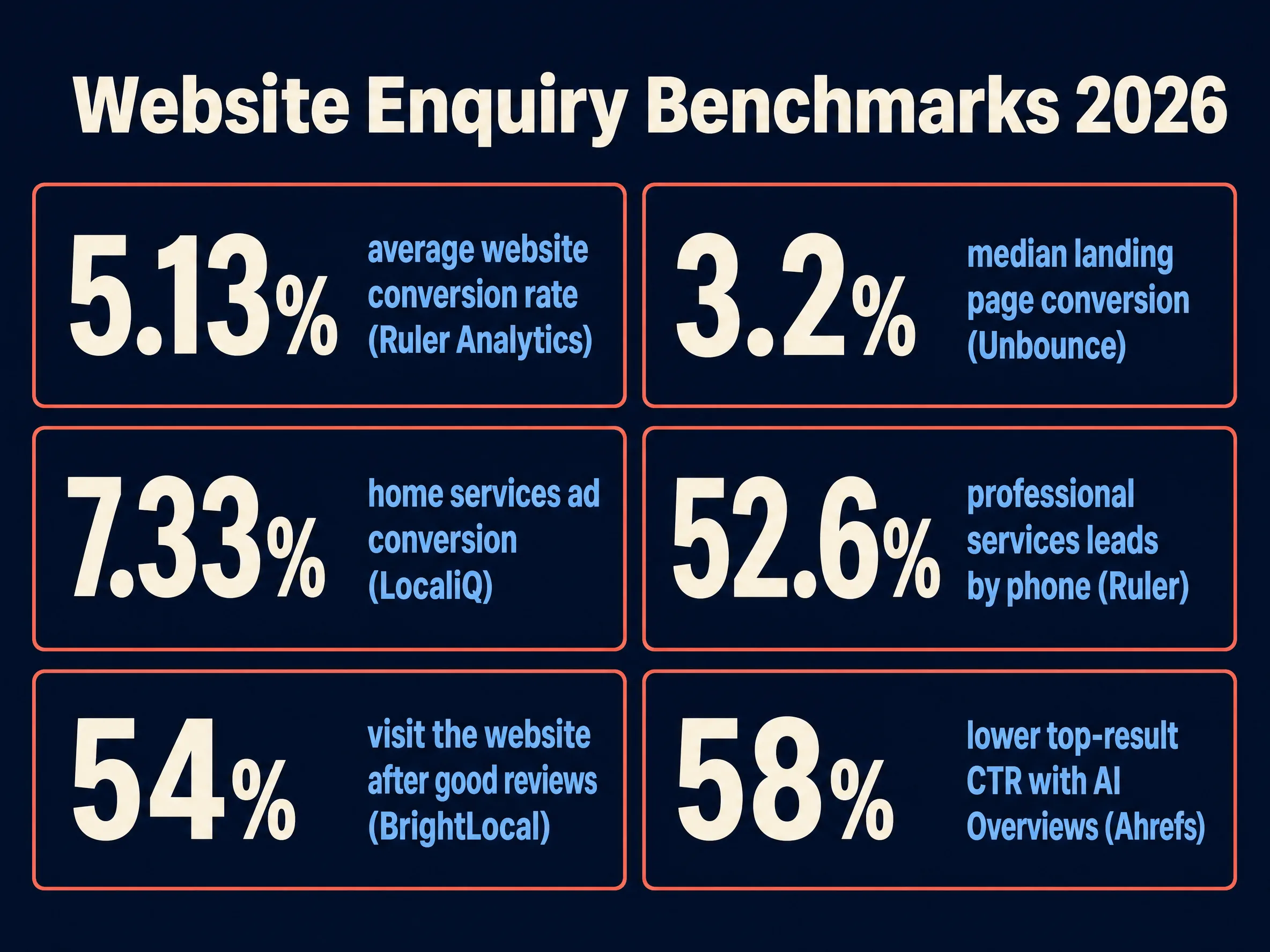
How many enquiries should a website get? Roughly 3 to 5 for every 100 visits: the median site converts 3.2% of visitors into enquiries and the 13-industry average is 5.13%, so 1,000 monthly visits should bring 32 to 51 enquiries.
Key Takeaways
- The average website converts 5.13% of sessions into a lead across 13 industries, from 110M+ sessions tracked by Ruler Analytics in 2026.
- The median landing page converts 3.2%; home improvement pages sit lower at 2.6% (Unbounce, 4,372 pages).
- At those rates, 1,000 visits a month should produce roughly 32 to 51 enquiries; 250 visits, roughly 8 to 13.
- Trades vary five-fold in paid search: cleaning converts at 17.65%, general contractors at 2.61% (LocaliQ, 3,211 campaigns).
- More than half of professional services leads (52.6%) arrive by phone, so a site without call tracking undercounts its enquiries.
- 54% of consumers still visit the business website after reading good reviews, even as 45% now use AI tools for local research (BrightLocal 2026).
- When an AI Overview appears, the top organic result loses 58% of its clicks (Ahrefs, 300,000 keywords).
How many enquiries should a website get per month?
A small business website should turn roughly 3 to 5 in every 100 visits into an enquiry. The Unbounce Conversion Benchmark Report puts the median landing page conversion rate at 3.2%, and Ruler Analytics' 2026 benchmarks put the average across 13 industries at 5.13%.
So the honest answer to "how many enquiries should my website get" is: it depends on visits. The table below does the arithmetic. Find your monthly visits in Google Analytics or your hosting dashboard, then read across.
| Monthly website visits | At 2.6% home improvement median | At 3.2% all-industry median | At 5.13% 13-industry average |
|---|---|---|---|
| 250 visits | 6 | 8 | 13 |
| 500 visits | 13 | 16 | 26 |
| 1,000 visits | 26 | 32 | 51 |
| 2,500 visits | 65 | 80 | 128 |
Most owner-run service businesses in Greater Manchester we speak to sit in the 250 to 1,000 visit band. That makes 8 to 51 enquiries a month the realistic range, with the low end meaning the site works but needs more traffic, and anything under 2% meaning the site is leaking.
The numbers are what Reddit keeps asking for. One owner on r/localseo posted their first month's data and asked whether it was "below average, average, or above average". The top reply on a r/googleads thread admitted "there’s no exact number since it totally depends on your local market". The benchmarks above give you that number.
What is a good website conversion rate for a small business?
A good website conversion rate for a small business is anything above 3.2%, the median, and a strong one is above 5%. Where you should sit depends on your sector, because some buyers are ready to call and others are browsing.
| Industry | Conversion rate | How leads arrive |
|---|---|---|
| Legal | 7.9% | 56.3% calls |
| Professional services | 6.1% | 52.6% calls |
| Construction & engineering | 4.9% | – |
| Beauty & cosmetic | 3.5% | 92.2% forms |
| Real estate | 2.8% | – |
| Health & social care | 2.3% | – |
| Average, 13 industries | 5.13% | – |
Ruler Analytics is a UK attribution company, and its data covers more than 110 million sessions and 5 million conversions. That makes it one of the few large conversion datasets with a UK base, rather than a US ad platform extrapolated to Britain.
Note the spread. A solicitor's site converting at 4% is underperforming its sector, while a care provider at 4% is well ahead. Before a website redesign or a new ad budget, check which side of your sector's line you are on.
How do website enquiry rates differ by trade?
Enquiry rates for trades differ roughly five-fold. LocaliQ's home services benchmarks, built from 3,211 US search campaigns, show cleaning services converting at 17.65% and general contractors at 2.61%.
| Trade | Conversion rate | Cost per lead |
|---|---|---|
| Cleaning services | 17.65% | $46.99 |
| Handyman | 13.45% | $54.05 |
| Electricians | 9.08% | $93.69 |
| Plumbing | 7.63% | $129.02 |
| Landscaping | 6.42% | $117.92 |
| Roofing & gutters | 3.70% | $228.15 |
| General contractors | 2.61% | $165.67 |
| All home services | 7.33% | $90.92 |
Two cautions. These are paid-search clicks, which carry stronger intent than the average organic visit, so treat them as a ceiling for your website as a whole. And they are US medians; UK costs per lead differ, but the ranking between trades holds for a clear reason.
Low-ticket, urgent jobs (a cleaner, a handyman, an emergency electrician) convert quickly because the buyer wants someone today. High-ticket, considered jobs (a roof, an extension) convert slowly because the buyer compares three quotes. If you are a builder converting at 3%, you are not failing; you are at the trade norm.
Should you count phone calls as website enquiries?
Yes. For most service businesses phone calls are the biggest share of website enquiries, and they are the share most sites never measure. Ruler Analytics found 56.3% of legal leads and 52.6% of professional services leads arrived by phone, not form.
Google Analytics 4 counts a form submission automatically once it is set up, but it cannot see a call made from a number on your contact page. A site that looks like it produces 6 enquiries a month from forms may be producing 13 once calls are counted.
The fix is call tracking: a unique number shown to website visitors, logged against the source. Feed both calls and forms into one CRM and your monthly enquiry count becomes a real number rather than a guess. Beauty businesses are the exception; Ruler found 92.2% of their leads come through forms and online booking.
Why is my website getting fewer enquiries than last year?
If enquiries have fallen while rankings look steady, the likeliest cause is fewer clicks from Google, not a worse website. The SparkToro and Datos zero-click study found 59.7% of EU Google searches ended without a click, and that was before AI Overviews spread.
Ahrefs' 2025 data across 300,000 keywords shows the top-ranking page loses 58% of its click-through rate when an AI Overview appears. Ofcom reports about 30% of UK searches now show one, and 53% of UK adults say they see these summaries often.
The buyer has not disappeared, though. BrightLocal's 2026 survey of 1,002 consumers found 45% now use ChatGPT or other AI tools to research local businesses, yet 54% still visit the business website after reading positive reviews. The website has moved from first touch to final check.
That changes what a good month looks like. Fewer visits at a higher conversion rate is normal now. Track enquiries and conversion rate, not sessions, and make sure your SEO and AI search visibility work are aimed at being the business the AI recommends.
What does a normal month of website enquiries look like for a local business?
For a local service business with a few hundred visits, a normal month is somewhere between 8 and 26 enquiries, counted across calls, forms and bookings. Below that range, the problem is usually conversion; above it, you are beating the median.
New sites run below that for the first few months. One agency owner on r/LocalServicesAds told an advertiser getting a handful of leads that "there’s likely more than 10 leads per month in the market", which is a fair rule of thumb for an established local trade.
Seasonality matters too. Heating engineers peak in autumn and landscapers in spring, so compare each month with the same month last year rather than the month before.
How do you get more enquiries from the same website traffic?
Raising your conversion rate is cheaper than buying more traffic, because every point of conversion applies to every visit. Moving 500 visits a month from 2% to 4% doubles enquiries from 10 to 20 without a penny more on ads.
The changes that move it most on small business websites are simple. Put a tap-to-call number and one clear call to action above the fold on mobile. Show the areas you cover, your prices or a price range, and recent reviews on the service page, not buried on a testimonials page. Cut the contact form to the fields you need to call someone back.
Then measure. Track calls, not just forms. Review enquiries per 100 visits monthly. If you want to see what a rebuild would cost against the extra enquiries, our website design cost calculator compares one-off and pay monthly over three years.